
Why Structural Insulated Panels?
SIPs aren’t a new idea — they’ve been used in high-performance construction for decades. But for ADUs specifically, they’re the clearest upgrade over conventional stick framing you can make. Here’s why.
~1 Day
Typical shell assembly
Up to R-40
Wall insulation value
~50%
Less air leakage vs stick frame
Title 24
California energy code — met
SPEED
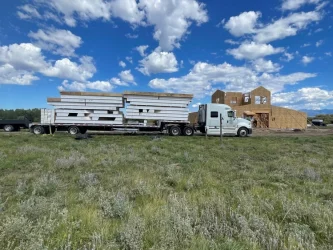
Built in a Day, Not a Week
Conventional stick framing means days of measuring, cutting, nailing, and correcting on-site. Every stud is cut by hand. Every piece of insulation is fitted separately. Weather delays everything.
SIPs panels are factory-engineered to your design before they ever leave the plant. They arrive on your lot labeled, sequenced, and ready to lift into place. A small experienced crew can stand the complete thermal envelope of an ADU2Me shell in a single day.
That’s not just faster — it’s less labor cost, less site exposure, and a faster path to dry-in.
INSULATION and ENERGY PERFORMANCE
Real Insulation. No Gaps, No Bridging.
Batt insulation fitted between studs has a fundamental problem: the studs themselves conduct heat. Every 16 inches, there’s a thermal bridge where the insulation stops and the wood begins. Over the entire wall, that adds up to real energy loss.
SIPs panels combine the structure and insulation into a single continuous engineered panel. There are no studs to bridge through. The insulation doesn’t have gaps or voids. What you get is a tighter, more consistent envelope — and real-world energy performance that matches what the specs say on paper.
For California homeowners and tenants, that means lower utility bills. For investors, it’s a tangible selling point that holds up over the life of the property.
CALIFORNIA ENERGY CODE
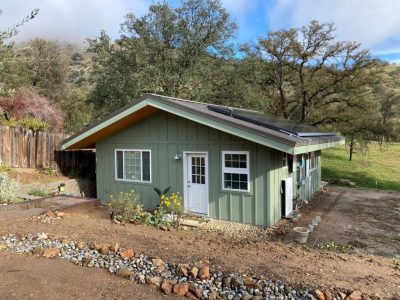
Designed for Title 24 from Day One
California’s Title 24 energy code sets some of the strictest building envelope requirements in the country. ADUs are not exempt — your shell needs to meet these standards before you can get a final inspection.
ADU2Me packages are engineered around Title 24 compliance. The panel thickness and insulation values in our designs are specified to meet California’s requirements, so you’re not retrofitting compliance at the end of a project — you’re building it in from the start.
That matters especially for Southern California, where cooling loads drive energy use and a tight, well-insulated envelope makes a measurable difference in comfort and cost.
STRENGTH & STRUCTURAL PERFORMANCE
Stronger Than It Looks
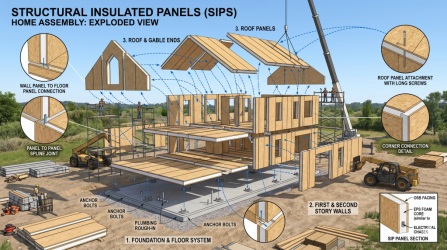
A SIPs panel is a structural sandwich — two layers of engineered sheathing bonded to a rigid foam core. The result is a panel that acts as a structural diaphragm, distributing loads across the entire surface rather than through individual studs.
In practical terms: SIPs structures perform well under the kinds of lateral and wind loads common in California. They’re not just an insulation upgrade — they’re a structurally superior system.
WASTE AND SUSTAINABILITY
Less Waste. Less Mess. Less Impact.
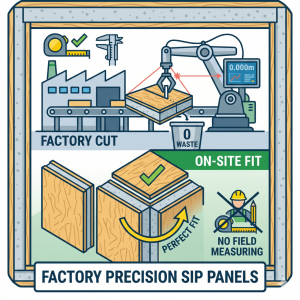
Stick framing generates substantial jobsite waste — offcuts, miscuts, damaged material, packaging. A typical residential frame leaves a significant pile of lumber scrap behind.
Because SIPs panels are factory-cut to your design’s exact specifications, very little material is wasted. What comes off the truck is what goes on the building. Your site stays cleaner, your crew moves faster, and less material ends up in a dumpster.
SIPs also contribute to lower operational energy use over the life of the building — which matters for California’s broader decarbonization goals and may support green building certifications depending on your full project scope.
SIPs vs. Stick Frame — Side by Side
| SIPs (ADU2Me) | Stick Frame | |
|---|---|---|
| Shell Assembly | ~1 day | Several days |
| Insulation Type | Continuous rigid foam — no gaps | Batt between studs — thermal bridging |
| Air Tightness | High — engineered envelope | Variable — depends on labor quality |
| Precision | Factory-cut to spec | Field-cut — human error factor |
| Jobsite Waste | Minimal | Significant |
| Title 24 Compliance | Engineered in | Requires additional detailing |
| Long-term Energy Cost | Lower | Higher |
Manufactured by Premier SIPS
